People’s Balus: Air Niugini Introduces the Airbus A220-300


Air Niugini Airbus A220-300 made its Singapore Airshow debut carrying far more than just the weight of a new aircraft type. Finished in a commemorative “50 Years of Independence” livery, the A220-300 represents a meaningful moment for Papua New Guinea’s national carrier. Presented here in Singapore, the aircraft serves two roles at once – a celebration of Papua New Guinea’s golden jubilee and a preview of how Air Niugini intends to connect its people and region in the years ahead.

P2-PGA: Air Niugini’s First Airbus A220-300
The aircraft on display carries particular weight. Registered as P2-PGA, it is the first Airbus A220 delivered to Air Niugini and the first of the type to enter service with the carrier. Named People’s Balus, it marks the opening chapter of Air Niugini’s A220 journey. Prior to stepping onto the aircraft, we were welcomed with traditional Papuan dance, a thoughtful gesture that grounded the experience firmly in Papua New Guinea’s heritage.

Delivered from the Airbus Final Assembly Line in Mirabel, P2-PGA arrived in Port Moresby via Vancouver, Honolulu, and Nadi – an itinerary that neatly illustrates the A220’s long-range capabilities despite its modest size. Its arrival at home was treated as a national event, complete with a flypast, cultural performances, and a ceremonial water salute.
Before the A220, an Aging Fleet at a Crossroad
The significance of the A220 becomes even clearer when viewed against the backdrop of Air Niugini’s previous fleet. Prior to the introduction of the A220, the airline operated a small and ageing fleet with an average of 21.3 years, comprising of just three Boeing 737s, two Boeing 767s and eight De Havilland Canada DHC-8 turboprops.
While these aircraft had served the airline reliably, they reflected the mounting challenges of operating older generation equipment: higher fuel burn, increasing maintenance demands, and limited flexibility in matching capacity to demand. For an airline tasked with connecting a geographically complex nation while remaining commercially viable, the need for renewal had become increasingly urgent.
The Airbus A220 Family: Redefining the Single-Aisle Aircraft Market
The Airbus A220 occupies a unique position in the commercial aircraft market. Designed from the outset as a clean-sheet aircraft for the 100-160 seat segment, it blends the economics of a regional jet with the comfort and range typically associated with larger narrowbodies. Since entering service in 2016, the A220 has steadily reshaped expectations of what a small single-aisle aircraft can deliver.
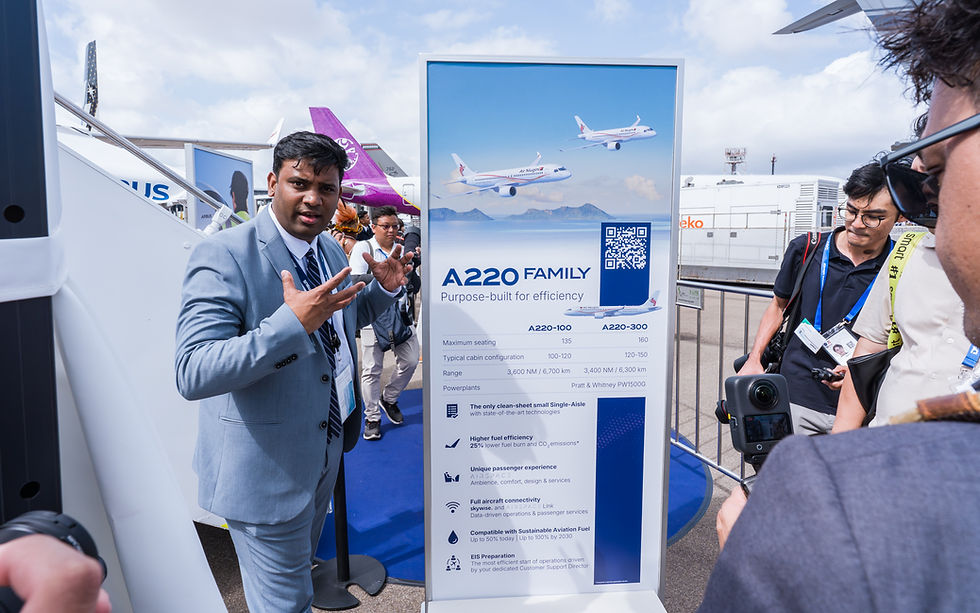
What stands out to me is how balanced the A220 family feels. Advanced aerodynamics, extensive use of lightweight materials and Pratt & Whitney Geared Turbofan engines reduce fuel burn and emissions compared with previous-generation aircraft. Simultaneously, the cabin is designed from the inside out, prioritising space, light, and comfort rather than simply maximising seat density.
A220-100 vs A220-300: Same DNA, Different Missions
Although they share a common platform, the A220-100 and A220-300 are optimised for different roles. The A220-100, typically seating around 100-135 passengers, is well suited to thinner routes and airports with performance constraints, making it an effective replacement for ageing regional jets and smaller narrowbodies.

The A220-300 extends that same design philosophy into the 120-160 seat category. With higher capacity and stronger seat-mile economics, it is better positioned for busier regional routes and longer international sectors that remain too thin for larger narrowbodies. Crucially, both variants share a high degree of commonality, allowing airlines to deploy them flexibly without adding complexity in pilot training or maintenance.
Why the A220-300 Makes Sense for Air Niugini
For Air Niugini, the decision to introduce the A220-300 is best understood through operating reality rather than headline specifications. On paper, aircraft such as the A319neo appear comparable, offering similar seating capacity, cruise speed, and range. In practice, however, the A220-300 aligns far more closely with the airline’s network requirements. Air Niugini operates in an environment defined by long sectors, challenging terrain, smaller airports, and demand that is often thin but essential. In such conditions, aircraft weight, climb performance, and trip economics matter far more than fleet commonality or containerised cargo capability.
This distinction is particularly relevant in the Asia-Pacific context, where “regional” flying can be as long as two to four hour sectors, infrastructure varies widely, and airports often impose runway length, noise, apron, and cargo handling constraints. The A220-300 lower MTOW, strong climb capability, and right-sized capacity translates directly into routes that are flyable, sustainable, and commercially viable. From a passenger perspective, the benefits are equally tangible: the 2-3 seating layout, larger windows, and quieter interior create a cabin that feels noticeably wider and more refined.
Business Class on the A220-300
Air Niugini A220-300 features a compact two-row Business Class cabin seating just eight passengers in a 2-2 configuration. The recliner-style seats offer a 20” width and 6” of recline.

Each seat is equipped with a universal AC power socket, alongside USB-A and USB-C charging ports, allowing passengers to keep multiple devices powered throughout the flight. There is no personal inflight entertainment screen, reinforcing that this is a practical, regionally focused Business Class product rather than one intended for long-haul missions. A dedicated forward galley and lavatory, combined with a solid bulkhead separating Business Class from Economy, providing a calm and private atmosphere in the front of the cabin.
Economy Class on the A220-300
Behind the Business Class sits the Economy Class cabin, arranged in a 2-3 configuration with 130 seats in total. Seat width measures a generous 18.5” paired with a 31” pitch, and 3” of recline with adjustable headrests. There is no personal inflight entertainment, but each seat is fitted with both USB-A and USB-C charging ports, ensuring passengers remain connected throughout the journey.
A thoughtful touch is the inclusion of a small integrated phone stand built into the seat in front. While simple, it reflect practical understanding of modern passenger behaviour, allowing personal devices to be comfortably propped up for streaming or reading without needing additional accessories.

The A220 Cabin Experience
Beyond individual seating products, the A220’s strongest selling point is the cabin itself. Airbus designed the aircraft from the inside out. One of the most striking features is the windows. They are genuinely large – larger than those on the Boeing 777 and positioned at eye level. Their size allows significantly more natural light into the cabin, which immediately makes the interior feel brighter, airier, and more spacious, particularly during daytime flights.
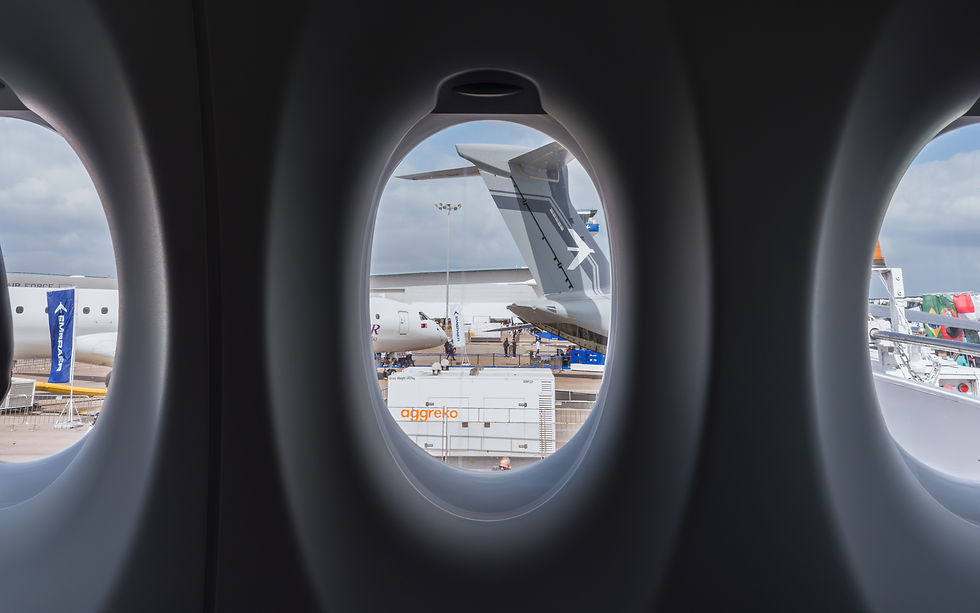
What stood out most to me was just how open the cabin felt overall. The A220’s efficient cross-section translates into noticeably more shoulder room and aisle space, and in my view, it feels significantly wider than the Embraer E195-E2, despite being in the same general size category. Combined with slimline leather seats, reduced cabin noise, and a well-proportioned aisle, the experience feels closer to a small widebody than a conventional regional jet.
As part of Airbus’ Airspace cabin family, the A220 also benefits from XL overhead bins, full-colour LED mood lighting, and extensive noise-dampening throughout the airframe. A lower cabin altitude and advanced climate control further reduce fatigue on longer sectors.
Why the 2-3 Seating Configuration on the A220
One of the defining choices in the A220’s design is the 2-3 seating configuration, and experiencing the aircraft in person makes the rationale clear. Compared with a 3-3 layout, the 2-3 arrangement reduces density, improves aisle and shoulder space, and significantly lowers the number of middle seats. Compared with a 2-2 layout, it allows airlines to retain efficient capacity without sacrificing comfort. More window and aisle seats, a wider-feeling cabin, and less visual crowding – an excellent balance between comfort and economics.

With the introduction of the People’s Balus, it marks a clear step away from an ageing, fragmented fleet and towards an aircraft designed around efficiency, flexibility, and passenger comfort. The A220 is not just about modernisation but also about Air Niugini using the right aircraft to sustainably connect a challenging network, while offering a noticeably improved experience for those onboard.


Comments