Singapore Airshow 2026: Meet the STAR — STARLUX’s Airbus A350-1000


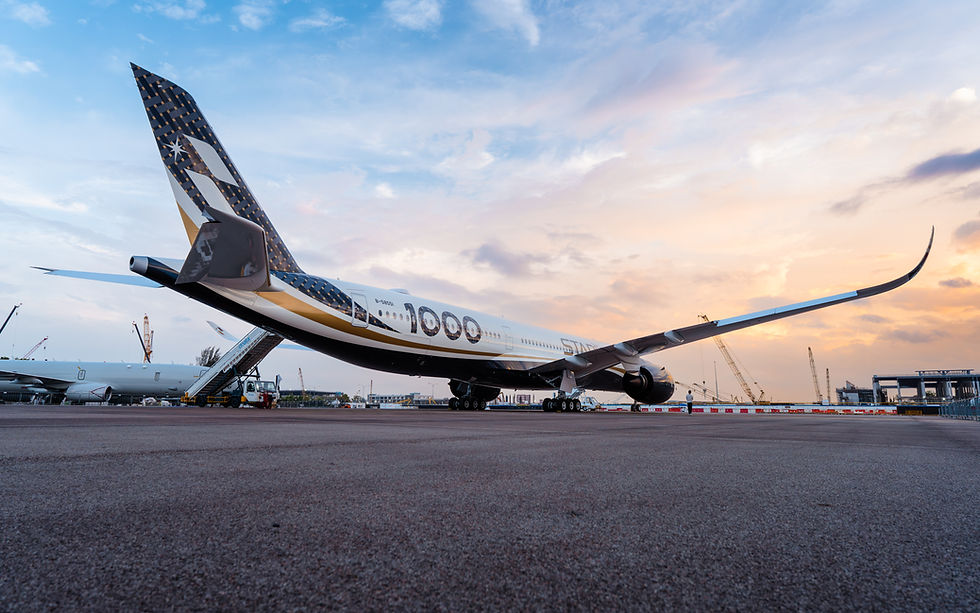
Walking across the Static Aircraft Display Area (SADA) at the Singapore Airshow 2026, I saw no shortage of headline aircraft. Yet one stood out not because it demanded attention, but because it carried itself with quiet confidence. Parked prominently at the centre of the SADA was an Airbus A350-1000, bearing the registration number B-58551, operated by STARLUX Airlines – Taiwan’s first A350-1000 and the airline’s new long-haul flagship.

I had the opportunity to tour the aircraft during the airshow, and it quickly became clear that this was not just another static display appearance. For STARLUX, bringing an actual A350-1000 to Singapore was a deliberate statement of intent: a signal that the airline has moved beyond its boutique beginnings and is now firmly positioning itself in the global long-haul, premium-focused arena.

STARLUX’s First A350-1000, B-58551: A New Flagship Takes Shape
Delivered on 06 January 2026, B-58551 is the first of 18 Airbus A350-1000s on order by STARLUX. As the largest and longest-range aircraft in the fleet, the A350-1000 underpins STARLUX’s next phase of long-haul growth, enabling premium-heavy operations while maintaining efficiency and fleet commonality.

To commemorate the arrival of its new flagship, STARLUX has introduced a subtle evolution of its visual identity on the A350-1000. The airline retains its familiar Obsidian Grey fuselage and Earth Gold accents, but layer in a distinctive carbon-fibre-inspired motif across the aircraft. The design directly references the composite-intensive construction of the A350 and reinforces the idea that this is a next-generation aircraft. A bold “1000” marking along the aft fuselage leaves little ambiguity about the aircraft’s role at the top of the fleet hierarchy.
Beyond aesthetics, the A350-1000 is widely regarded as a benchmark in the large widebody segment. With a range of up to 16,700km, a cruise speed of Mach 0.85, and a 322-tonne MTOW, it is optimised for demanding intercontinental missions. Constructed from approximately 70% advanced materials and powered by two Rolls-Royce Trent XWB engines, the aircraft delivers lower fuel burn, reduced emissions, and one of the quietest cabin environments in its class.
Airspace Cabin: A Space Designed to be Lived In
The A350-1000 is a founding member of Airbus’ Airspace cabin family, and that philosophy is immediately evident once onboard. Rather than feeling purely functional, the cabin feels intentionally shaped around how passengers experience long-haul travel.
High ceilings, wide aisles, and effective acoustic insulation create a sense of openness, while adaptive lightly subtly guide passengers through different phases of flight. The result is a cabin environment that feels clam and composed – qualities that become increasingly important on sectors lasting well into double-digit hours.
The A350-1000 in the Air: The Demonstrator at Work
The aerial display flown by the Airbus A350-1000 demonstrator F-WMIL. What stood out most was how unstrained the aircraft looked throughout the sequence. Even during high-alpha passes and tight banking turns, the A350-1000 never appeared hurried or heavy. Control inputs were smooth, transitions were clean, and the aircraft carried itself with confidence.
Acoustically, the display was just as telling. For an aircraft of this size, engine noise remained surprisingly restrained, allowing the focus to stay on the aircraft’s movement rather than its presence. From a visual perspective, the long fuselage, sweptback sharklets, and subtle wing flex came together to create a silhouette that looked modern and balanced in the air.
A Contemporary Alternative at the Top End
At the top end of the long-haul market, the Airbus A350-1000 comes across as a modern well-balance flagship rather than an aircraft built purely around size. Seeing it up close and watching it fly, it feels designed with today’s long-haul reality in mind – quiet, efficient, and focused on passenger comfort.

While it is often mentioned alongside other large widebodies like the Boeing 777-9X, I found the A350-1000 easier to understand in practical terms. It feels right-sized for long routes that prioritises premium passengers, offering strong range and capability without feeling excessive. More importantly, it already feels like a finished, proven product and fits naturally into how airlines operate and how passengers experience long-haul travel today.
A Full Fleet Circle in Singapore
With the appearance of the A350-1000 at the Singapore Airshow, STARLUX has now, at different points in time, brought all four aircraft types in its fleet to Singapore – though not all in commercial service.
STARLUX’s Singapore story began on 23 September 2021, when the airline inaugurated its service with the Airbus A321neo, marking one of its earliest international expansions beyond Taiwan. That was followed by visits from the Airbus A350-900, which operated into Singapore shortly after delivery as part of pilot familiarisation and training.
The introduction of the Airbus A330-900neo marked the next phase. The A330neo has since become a daily fixture on the Singapore route and was also featured at the Singapore Airshow 2024, where it represented STARLUX’s then flagship widebody.
The Airbus A350-1000 completes that picture, albeit in a different context. Its presence in Singapore is tied specifically to the airshow, rather than scheduled commercial service.
STARLUX Cabin Design Philosophy: “Glisten”
Inside, the cabin design – created by BMW Designworks – follows the “Glisten” concept already seen on the STARLUX’s A350-900 fleet. The emphasis is on comfort, privacy, and a sense of belonging, achieved through layered lighting, reflective surfaces, and carefully chosen textures.

While familiar in layout, the A350-1000 benefits from additional space, particularly in the premium cabins, giving the aircraft a more relaxed and balanced feel overall.
First Class: Privacy as the Primary Luxury
First Class on the STARLUX Airbus A350-1000 is limited to just four suites in a 1-2-1 layout, and that small scale defines the experience. Each suite is fully enclosed with privacy doors and centred around a widened seat that converts into a fully flat bed, offering an 83” pitch, 23” seat width, and a zero-gravity recline mode designed to reduce fatigue on long flights. One of the strongest aspects here is storage: between the personal locker, multiple compartments, and thoughtfully placed surfaces, the suite feels genuinely uncluttered and easy to live in over a long sector.

A notable highlight is the personal minibar, stocked with canned beverages as well as still and sparkling water. It is a small detail, but one that elevates the whole travel experience. In that sense, it feels closer to what Emirates offers in its premium cabins, where self-service refreshments reinforce the sense of autonomy and control.
That said, one design compromise remains: First Class shares the same forward cabin zone as Business Class, without a physical partition. While the privacy doors help, the relatively low wall panels mean movement from the Business Class cabin remains visible – slightly softening the exclusivity I would expect when paying for First Class.
Seat Highlights
4 seats | 1-2-1 configuration
83” pitch | 23” width | 180° lie flat
32” 4K UHD touchscreen IFE
110V AC, USB-A, USB-C & wireless charging
Bluetooth audio | privacy doors
Business Class: Designed for Long Haul Reality
Business Class on the STARLUX A350-1000 is arranged in a 1-2-1 configuration with 40 seats, offering direct aisle access throughout and a pitch of 44” pitch. The seat converts into a fully flat bed and feels purpose-built for long sectors. Each seat features a 24” 4K UHD screen, ample side-console space, enclosed storage, wireless charging and full power connectivity. Compared to my experience on STARLUX’s A330-900neo, the most noticeable difference is the larger IFE screen and the addition of privacy doors on the A350 family. Those doors add a meaningful layer of separation and elevate the seat from a traditional business product to something closer to a Business Suite, especially on overnight flights.

What stood out during the tour is how closely the Business Class seat mirrors the First Class product in overall design language. In many ways, the core experience is surprisingly similar. The key differences come down to extra legroom, a wider seat, higher wall panels, larger privacy doors, and the addition of a personal minibar in First Class. Whether that justifies the upgrade depends largely on what one values most. Business Class on the A350-1000 already delivers a highly complete experience, but if you are a traveller who prioritises space, autonomy, and a stronger sense of separation, First Class still holds a clear edge.
Seat Highlights
40 seats | 1-2-1 configuration
44” pitch | 21” width (23.6” bed) | 180° lie flat
24” 4K UHD touchscreen IFE
110V AC, USB-A, USB-C & wireless charging
Bluetooth audio | privacy doors
Premium Economy: Where the Upgrade Truly Matters
Premium Economy is laid out in a 2-4-2 configuration across 36 seats, with a generous 40” pitch that immediately sets it apart from Economy. The seat feel noticeably wider, legroom is ample, and the 8” recline is enough to make a real difference on long-haul flights. This cabin clearly functions as a genuine middle ground rather than just a token upgrade.

Having previously flown on STARLUX’s Premium Economy on the A350-900 from Bangkok to Taipei, the experience here feels familiar and reassuringly consistent. The seats are modern and well cushioned, the 15.6” HD touchscreen IFE is responsive, and Bluetooth connectivity allows passengers to use their own headphones or earbuds. Combined with upgraded bedding and a clam cabin atmosphere enhanced by STARLUX’s signature scent, this is a cabin I would happily choose again and certainly justifies the premium pricetag.
Seat Highlights
36 seats | 2-4-2 configuration
40” pitch | 18.7” width | 8” recline
15.6” HD touchscreen IFE
110V AC, USB-A, USB-C & wireless charging
Bluetooth audio | 6-way adjustable headrest
Economy Class: Consistency & Practical Comfort
Economy Class features 270 seats in a 3-3-3 layout, with a pitch of 31”. While this is a high-density cabin, the A350’s wide fuselage and high ceilings prevent it from feeling overly tight, particularly when combined with consistent lighting and clean cabin lines.

One strength of STARLUX’s Economy product is consistency. Both the A330-900neo and A350 family use the same Recaro CL3710 seats, meaning long-haul Economy passengers get the same seat design, 13.3” touchscreen IFE, Bluetooth audio, and full power options.
By comparison, the A321neo’s Collins Meridian seats feel more basic, with smaller screens, fewer adjustments, and no Bluetooth support. On the A350, Economy feels properly long-haul ready.
Seat Highlights
270 seats | 3-3-3 configuration
31” pitch | 18” width | 5” recline
13.3” HD touchscreen IFE
110V AC, USB-A & USB-C
Bluetooth audio | 6-way adjustable headrest
Closing Thoughts
After touring the aircraft and watching it perform in the air at the Singapore Airshow 2026, the Airbus A350-1000 feels less like a statement aircraft and more like a logical progression. It reflects an airliner that is no longer experimenting with scale, but refining it.
As STARLUX’s new long-haul flagship, the A350-1000 feels calm, deliberate, and confidently modern – qualities that mirror both the aircraft itself and the airline’s trajectory going forward.


Comments