COMAC Brings the C919 to the Singapore Airshow 2026


The COMAC C919 is no stranger to international audiences. While its first appearance outside mainland China was a flypast over Victoria Harbour in Hong Kong, it made its international airshow debut at the Singapore Airshow in 2024. It has since appeared at other major airshow, including Dubai Airshow, before returning once again to Singapore in 2026.
Who is COMAC?
The Commercial Aircraft Corporation of China (COMAC) was founded in May 2008 in Shanghai as China’s state-owned commercial aircraft manufacturer. Its mandate is clear – develop passenger aircraft capable of competing with the Airbus-Boeing duopoly.

Its first product, the ARJ21 (now rebranded as the C909), entered service in early 2010s and operates primarily within China and parts of Southeast Asia. But the true centrepiece of COMAC’s ambition is the C919 – China’s first domestically developed narrowbody jet designed to compete directly with the Airbus A320neo and Boeing 737 MAX aircrafts.
The C919 Programme
The C919 conducted its maiden flight on 05 May 2017 and entered commercial service in 2023. In a two-class configuration, it seats approximately 158-168 passengers, with a maximum capacity of 190. The name itself represents a few things…
“C” may represent China or COMAC.
“9” is associated with longevity in Chinese culture as 九 (jiǔ) sounds like 久 (jiǔ), meaning long-lasting.
“19” refers to its maximum seating capacity of 190 passengers.

Made in China, Globally Sourced
Although the aircraft is fully assembled in China, the C919 integrates numerous Western systems. Most notably, it is powered by the CFM International LEAP-1C engine. The LEAP family also powers the C919 competitors – Airbus A320neo (LEAP-1A) and Boeing 737 MAX (LEAP-1B).
The LEAP-1C incorporates advanced materials such as 3D-woven composite fan blades and ceramic matrix composites, improving fuel efficiency and reducing noise.
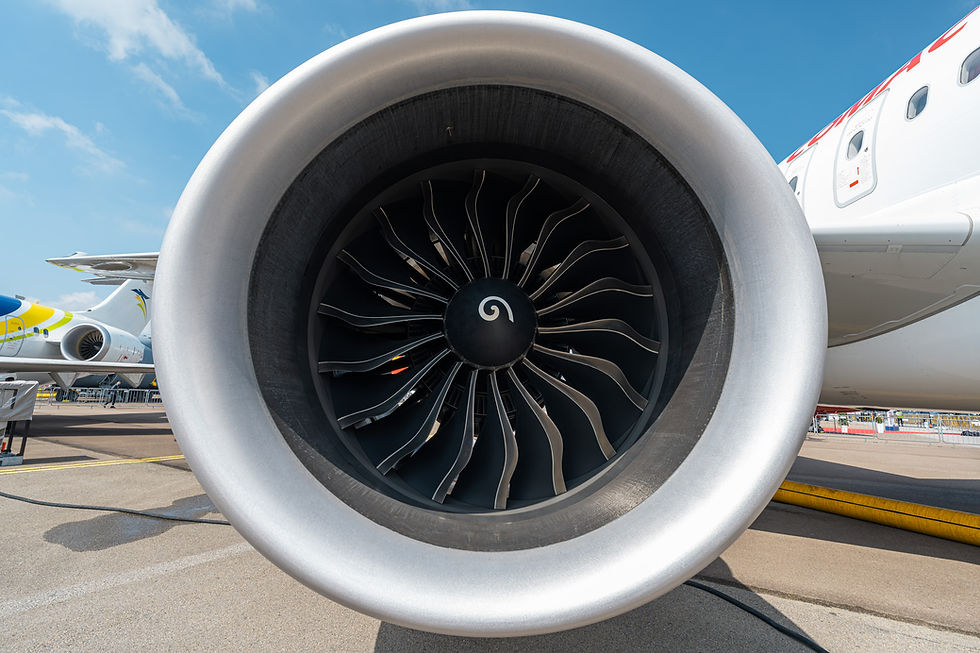
While reliance on Western components enhances reliability and maturity, it also introduces exposure to export controls and supply-chain constraints. COMAC’s long-term ambition is to power the aircraft with the domestically developed CJ-1000A engine.
Certification & Production Realities
Developing a commercial airliner from scratch is very complex. The C919 received its CAAC type certificate in September 2022. China Eastern Airlines operated the first commercial service in May 2023. However, certification from EASA and FAA remains pending. COMAC has reinstated its EASA application, with estimates suggesting the process may take several years.
Production ramp-up has also been gradual. Compared to Airbus and Boeing, which produce dozens of aircraft monthly, COMAC remains in the early stages of industrial scaling. As of early 2026, 28 aircraft are in service – all with Chinese carriers.
Expanding the Family – C919 Variants
Like its Western competitors, COMAC is expanding the C919 family.
Variant | Design |
C919-100STD | Baseline version with approximately 4139km range, optimised for domestic and regional routes. |
C919-100ER | Extended-range variant capable of flying approximately 5576km, enabling longer regional sectors. |
C919-600 (Plateau) | Shortened 140-seat model designed for high altitude airports such as Lhasa and Qamdo, where thinner air demands improved thrust-to-weight performance. |
C919-800 (Stretch) | Proposed 200+ seat variant developed with China Eastern Airlines, aimed at competing in higher-capacity narrowbody markets. |
This mirrors the strategy used by Airbus and Boeing in segmenting their A320neo and 737 MAX families across multiple capacities and ranges.
Positioning Against Airbus and Boeing
In the narrowbody market, production segmentation is critical.
Airbus deploys sharklets on the A320neo.
Boeing uses Advanced Technology Winglets on the 737 MAX.
COMAC chose to adopts a raked wingtip-style design on the C919.
All aim to reduce induced drag and improved efficiency.
While Airbus and Boeing benefit from decades of ecosystem maturity, global support networks, and regulatory certification, the C919 represents China’s first serious, scalable entry into this competitive space.
COMAC Express – Demonstration and Outreach
To support market engagement, COMAC established COMAC Express in 2020 as an operational demonstration platform. Its fleet includes four ARJ21 aircraft and one C919-100STD. At the Singapore Airshow 2026, COMAC displayed the ARJ21 (B-3322) and C919 (B-658M) under the COMAC Express banner. Bringing the C919 to Singapore shows COMAC strategy to bring the aircraft to regulators, airlines, and markets rather than waiting for them to come to Shanghai.

Onboard the COMAC Express C919 – B-658M
Business Class
The aircraft features 8 seats in a 2-2 configuration.
The first impression was warmth rather than spectacle. The recliner-style seats are appropriate for short-to-medium haul missions. The beige and taupe tones create a calm environment, while embroidered pillows featuring Chinese motifs reinforce national identity without overwhelming the space.
Seat width and cushioning are competitive with regional Airbus and Boeing narrowbody products. It is not a lie-flat product but feels competent, though more conservative than some of the latest A320neo and 737 MAX premium cabins.
Economy Class
The 156-seat Economy cabin follows a standard 3-3 layout.

Here, the design becomes bolder. The vibrant red upholstery gives the cabin energy and presence – a departure from muted greys and blues favoured by many airlines. Seats are slim, with a standard 18” width and approximately 30” pitch – comparable to current narrow body norms.
The windows appear slightly larger than those on the A320 family, allowing generous natural light, contributing to an airy feel. However, while the overhead bins feature a pivot design, they are relatively shallow. Cabin bags must lie-flat rather than be stored vertically on its side, limiting capacity compared to the latest Airbus and Boeing bin designs.

Would I Fly on the C919?
At this stage, I probably wouldn’t – at least not by choice. While the cabin feels bright and structurally solid, the overall experience comes across as basic rather than premium.
The Business Class product is functional but lacks refinement, and the Economy seats feel noticeably slim. With a 30” pitch, limited personal storage, and relatively shallow overhead bins that require bags to lie-flat, the cabin can feel tight and constrained.
That said, this is less about safety or build quality and more about passenger experience. For now, more established narrow body products still hold the edge in comfort and cabin sophistication.

😍