Celebrating 20 Years of Operations: Inside Boeing’s Singapore Facility

Twenty years after operations began in 2006, Boeing’s largest training campus in Asia continues to provide world-class training for its customers.

Near the heart of one of the world’s busiest airports—Changi International Airport—Boeing’s Singapore training campus allows pilots to experience wind shear, lose sight of a runway in zero-visibility conditions and practise landings without ever leaving the ground or setting foot in an aircraft.
The company’s largest aviation training facility in Asia operates around the clock, 24 hours a day, seven days a week. It hosts modernly designed classrooms, flight training devices and full-flight simulators that support its customers long after they take delivery of an aircraft.
As busy as its Singapore campus already is, Boeing’s 2026 workforce outlook forecasts demand for 674,000 new pilots worldwide through 2045, including 66,000 in Southeast Asia. Those projections sit alongside the continuing training requirements of pilots already flying.
That projected demand adds pressure on training capacity, making experienced instructors, reliable simulators and efficient scheduling increasingly important. Boeing’s Singapore campus draws on two decades of operations and a wider global training network—after all, this is not Boeing’s first rodeo. Highly skilled simulator technicians keep equipment ready for use, sharp-eyed schedulers coordinate training slots, and experienced instructors guide crews through structured lessons and assessments. Together, their work supports an operation that runs 24/7.

Twenty years in Singapore
Boeing invited YourSafetyPilot and Plane’s Portrait Aviation Media, amongst others, to visit the Singapore campus as it marked 20 years of operations. The centre began operating in October 2006, while its official opening took place on January 18, 2007.

Today, Boeing lists six full-flight simulators and five flight training devices at its Singapore facility. The simulator fleet covers the 737 Next-Generation, 737 MAX and 777-300ER, alongside three devices for the 787-9, according to its campus inventory. That range allows the site to serve airlines operating both narrowbody and widebody aircraft.
Singapore belongs to a wider network that includes Seattle and Miami in the United States, London-Gatwick in the United Kingdom and Shanghai in China. Boeing also lists Istanbul in Türkiye as a flight training campus and delivers training at customer locations. The equipment and courses vary from site to site, depending on operational needs.
A place to rest and energize: the lounge

A well-kept lounge cannot establish the quality of a training programme on its own. But what it can do, however, is to give staff and crews a place to prepare and take a break away from everybody’s cognitively busy schedules. The lounge we visited featured coffee machines, highchairs, group table seating and a common fridge—everything you will want for a comfortable place to relax in. (Photo: Refreshments and seating in the campus lounge during the visit. Credit: YourSafetyPilot.)
Learning the sequence
Before heading into the full-flight simulators (FFS), trainees may first be in the classroom with comparatively lower fidelity training devices, with the cockpit appearing first on a large screen. Still, this is beyond a massive upgrade from traditional cockpit posters. In this particular set-up, a smaller touch-screen interface on the desk lets learners work through Flight Management Computer (FMC) tasks while an instructor guides their progress. Every lesson sets out both the scope of the session and the standards expected at its conclusion, phrased as “exit standards”.
A digital flight-deck display with desktop FMC training interfaces. Credit: YourSafetyPilot. An instructor guides a participant through the training interface. Credit: Plane’s Portrait Aviation
Pilot competency framework

Under Competency-Based Training and Assessment, or CBTA, instructors examine how pilots apply their knowledge and skills as a situation develops, paying attention to the communication, judgment and coordination that shape the outcome. ICAO sets out the approach for pilot training, which training organisations adapt to their programmes, including Boeing, whose Pilot Competency Framework brings together manual flying, automation, procedures and technical knowledge with situation awareness, workload management, decision-making, communication, and leadership and teamwork.
CBTA can also give instructors a way to examine the behaviours behind a result that is required of a competent pilot. A crew may technically complete a manoeuvre but communicate poorly. In a task-based assessment, this might have been a ‘pass’. In CBTA, however, completing the task alone may not establish competence, because the assessment also considers observable behaviours and patterns through which pilots demonstrate the wider abilities required for effective flight operations. Task-based training remains a foundation, Boeing says, with CBTA broadening the focus to how pilots bring those abilities together.
Learn more about CBTA here: https://services.boeing.com/training-solutions/flight-training/flight-competency-based-training-and-assessment
Flight Training Device (FTD)
The Flight Training Device, or FTD, puts what the student has learnt into a more cockpit-like setting. Not to be confused with an FFS (Full-flight Simulator), the FTD is a fixed-base set-up with a focus on physically matching what the student has learnt in theory into something to scale. Unlike an FFS, the FTD substitutes certain components—such as the overhead panel—with a flat-panel digital screen.
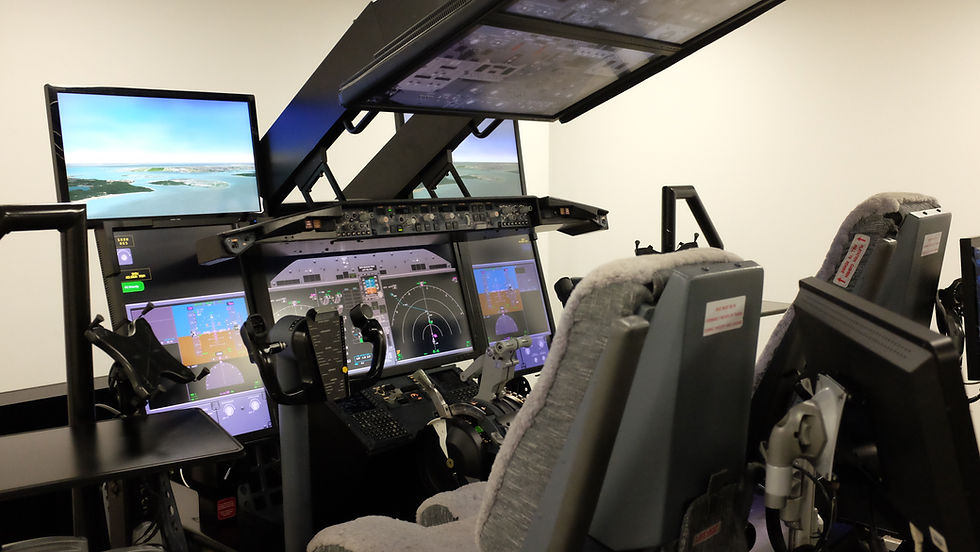
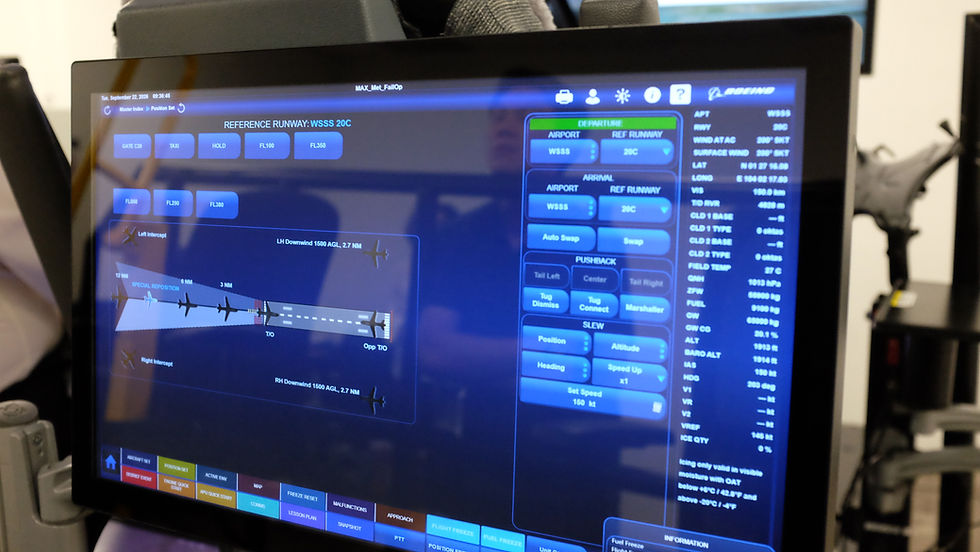
Crews use this class of device to rehearse procedures, work with the flight management system and practise monitoring automated flight. The precise scope depends on the device and approved course.

The low-visibility demonstration during our visit showed how a scenario unfolds when external cues disappear. That gives an instructor a setting in which to discuss instrument use, situational awareness and coordination without moving the platform.
Full-flight Simulator (FFS)

Boeing 737 MAX FFS cockpit. Credit: YourSafetyPilot Motion base of the Boeing 787 FFS. Credit: YourSafetyPilot
The FFS is about as real as it gets. In fact, the realism is so real that time spent on the simulator is considered extremely precious, lucrative, and always calculated. These simulators can simulate even the tiniest of motions and vibrations representative of a real aircraft—capable of six degrees of freedom: being able to move forwards and backwards, sideways and vertically, and rotate in pitch, roll and yaw. Control-loading equipment provides resistance and feedback at the controls.

One of the less obvious pieces of engineering is how much sensation can come from limited travel. Flight simulators use advanced motion-cueing techniques to make short movements represent aspects of a much longer flight. A platform can tilt gradually so that gravity contributes to the sensation of acceleration, a technique known as tilt coordination. Motion filters help keep the platform within its available space.

Meeting the requirements of regulators
Boeing says the campus works with more than 14 regulators to meet requirements across customer jurisdictions.
Boeing Singapore Campus continues to excel in fulfilling the demands of the aviation industry
If YourSafetyPilot were to describe the campus in a few words, it would be professionalism, hospitality, safety, and technology.
Twenty years after operations began, the Singapore campus continues to bring those elements together in one place.
YourSafetyPilot and Plane’s Portrait Aviation Media thank Boeing’s communications team for hosting the visit. (P.S. You all rock!)
YourSafetyPilot stands by responsible journalism and in upholding the integrity of the organisation. We are not immune to accidentally publishing material with misleading or biased information. If you think you may have spotted something worth correcting or clarifying, please e-mail it to us at: tips@yoursafetypilot.com. Alternatively, you may drop any of our members or page a direct message should that be more convenient for you.
We keep accountable by publishing all corrections and clarifications made to all our posts, which can be tracked on our dedicated page at:


Comments